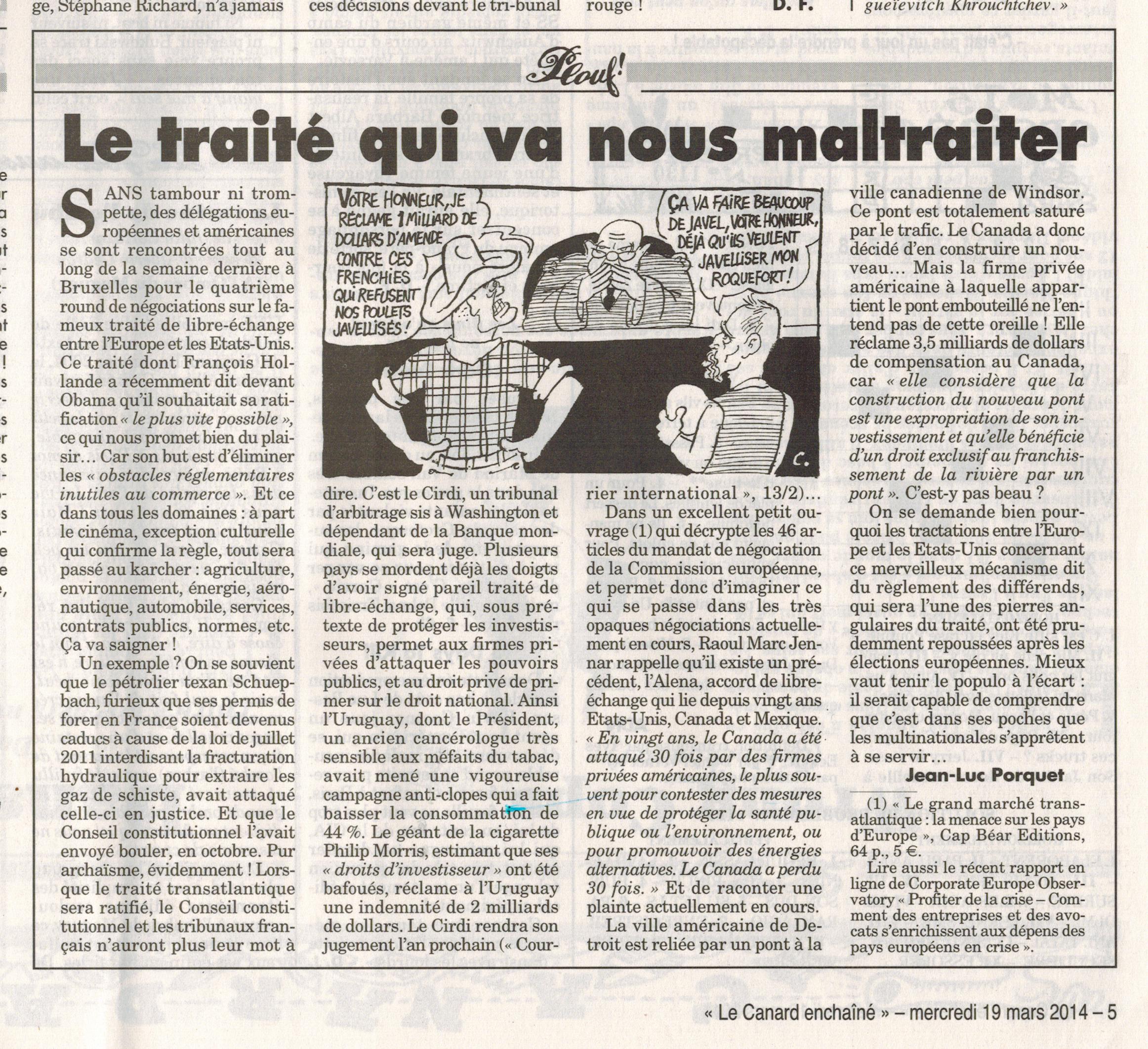
[LeCanardEnchaîné] Le traité qui va nous maltraiter | La Quadrature du Net
[LeCanardEnchaîné] Le traité qui va nous maltraiter | La Quadrature du Net
Article publié dans Le Canard Enchaîné du 19 mars 2014.
SANS tambour ni trompette, des délégations européennes et américaines
se sont rencontrées tout au long de la semaine dernière à Bruxelles
pour le quatrième round de négociations sur le fameux traité de
libre-échange entre l’Europe et les Etats-Unis. Ce traité dont François
Hollande a récemment dit devant Obama qu’il souhaitait sa ratification « le plus vite possible », ce qui nous promet bien du plaisir… Car son but est d’éliminer les « obstacles réglementaires inutiles au commerce ».
Et ce dans tous les domaines : à part le cinéma, exception culturelle
qui confirme la règle, tout sera passé au karcher : agriculture,
environnement, énergie, aéronautique, automobile, services, contrats
publics, normes, etc. Ça va saigner !
[LeCanardEnchaîné] The treaty will mistreat us

Article published in The Chained Duck March 19, 2014.
WITHOUT fanfare, European and U.S. delegations met throughout last week
in Brussels for the fourth round of negotiations on the famous treaty
of free trade between Europe and the United States. This treaty François Hollande said recently that he wanted Obama to his "soon as possible" ratification, which promises a lot of fun ... because its purpose is to eliminate "unnecessary regulatory barriers to trade."
And in all areas except the cinema, cultural exception that proves the
rule, everything will be passed karcher: agriculture, environment,
energy, aerospace, automotive, services, public procurement, standards,
etc.. There will be blood!
An example?
We remember that the Texas oil Schuepbach, furious that his permit to
drill in France have become obsolete because of the law of July 2011
prohibiting hydraulic fracturing to extract shale gas, attacked it
justice. And that the Constitutional Council had sent rounding in October. Pure archaism, of course! When the transatlantic Treaty shall be ratified, the Constitutional Council and the French courts will not have a say. This is the ICSID, an arbitration court located in Washington and dependent on the World Bank, which will judge.
Several countries already bitterly regret having signed such a treaty
of free trade, which, under the pretext of protecting investors, allows
private firms to attack the government, and the private right of
precedence over national law.
And Uruguay, whose President, a former oncologist very sensitive to the
harmful effects of tobacco, had led a vigorous anti-cigarettes campaign
that reduces fuel consumption by 44%.
The cigarette giant Philip Morris, saying that his "investor rights"
have been violated, claims to compensation Uruguay 2 billion. ICSID render its judgment next year ("Courrier International", 13/2) ...
In an excellent little book
that decrypts the 46 articles of the negotiating mandate for the
European Commission, and thus allows us to imagine what is happening in
the very opaque negotiations currently underway, Raoul Marc Jennar
remember there is a precedent, 1'A1ena, free trade agreement that binds
the past twenty years the United States, Canada and Mexico. "In
twenty years, Canada has been attacked 30 times by U.S. private firms,
often to challenge measures to protect public health or the environment,
or to promote alternative energy. Canada has lost 30 times. "And to tell a complaint underway. The U.S. city of Detroit is connected by bridge to the Canadian city of Windsor. This bridge is completely saturated with traffic. So Canada has decided to build a new ... But the private American company that owns the bridge bottled does not hear this! It claims 3.5 billion compensation in Canada because "it
considers that the construction of the new bridge is an expropriation
of its investment and enjoys an exclusive right to cross the river by a
bridge." That is it not beautiful?
One wonders why the negotiations between Europe and the United States
said about this wonderful mechanism of dispute settlement, which will be
one of the cornerstones of the Treaty have been carefully pushed after
the European elections.
Better to keep the rabble away: he would be able to understand that it
is in his pockets that multinationals are ready to use ...
Jean-Luc Porquet